
Prince George Forklift Training Programs
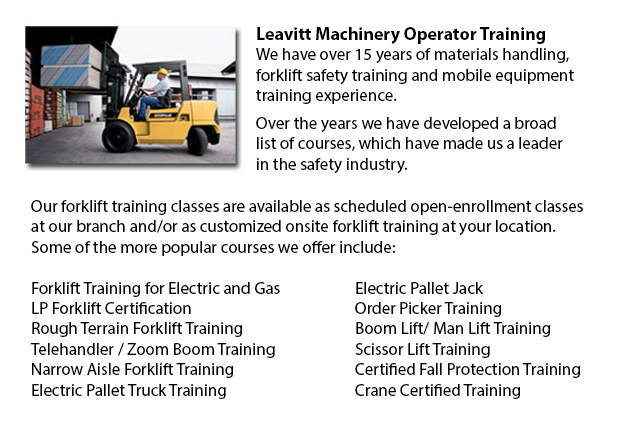

Prince George Forklift Training Programs - If you are looking for work as an operator of a forklift, our regulatory-compliant forklift training programs offer exceptional instruction in many types and styles of lift trucks, classes on pre-shift check, fuel types and handling of fuels, and safe utilization of a forklift. Practical, hands-on training assists those participating in acquiring fundamental operational skills. Program content comprises existing regulations governing the use of lift trucks. Our proven forklift programs are meant to offer training on these kinds of trucks: counterbalanced forklift, powered pallet trucks and narrow isle forklift.
How to Handle Loads Safely
Do not lower or raise the fork while the lift truck is traveling. A load must not extend above the backrest due to the possibility of the load sliding back in the direction of the operator. Inspect for overhead obstacles and ensure there is adequate clearance prior to lifting a load. Stay away from overhead power lines. Once the load is lifted straight up, tilt it back slightly.
The lift truck is less stable if a load is in a raised position. Ensure that no one ever walks under the elevated fork. The operator must not leave the forklift while the load is raised.
The forks should be level when handling pallets, and high enough to extend all the way into and underneath the load. The width of the forks must provide even distribution of weight.
Set the brakes and chock the wheels prior to loading and unloading the truck. The floors should be strong enough to support the combined weight of the forklift and its load. Fixed jacks can be installed to be able to support a semi-trailer that is not coupled to a tractor. The height of the entrance door must clear the forklift height by a minimum of 5 cm. Mark edges of rail cars, ramps or docks and avoid them.
If there is not proper ventilation into the forklift, do not stay in there for long periods. The trucks interior must have enough lighting and be obstruction free. Inspect the forklift cab's flooring for holes. The installation of nonslip material on the floor will help prevent slipping. Clear whichever obstructions from docks and dockplates and make certain surfaces are not oily or wet.
Lift trucks must not be used to tow or push other forklifts.

-
Prince George Telehandler Operator Training
Prince George Telehandler Operator Training - Telehandler forklifts or Telescopic Handler forklifts are common industrial machines found in various construction industry settings. The telehandler is a useful machinery and makes for a valuable tool wh... More -
Skid Steer Loader Certification in Prince George
The engine powered skid-steer loader comprises a small and rigid frame, equipped with lift arms that could attach to many industrial attachments and tools to execute several labor saving tasks. Normally, skid-steer loaders are four-wheel drive vehicl... More -
Prince George Telehandler License
Prince George Telehandler License - The telescopic handler or telehandler is a generally utilized machine in agricultural and industrial applications. This machine is the same in look to a forklift and also works in a similar manner, although telehan... More -
Prince George Manlift Ticket
Prince George Manlift Ticket - The Elevated Platforms and Manlifts Certification course helps to provide the needed training on the work practices, safe operating procedures, rules and regulations regarding the everyday activities for the operators o... More -
Prince George Manlift Operator Training
Prince George Manlift Operator Training - A specialized kind of hydraulic platform is referred to as an aerial lift or a man lift. It is designed to hoist an individual vertically up and down and thus, is likewise called a vertical personnel lift. Th... More -
Prince George Forklift Safety Training
Prince George Forklift Safety Training - Individuals wanting work in industries that utilize forklifts have to undergo a forklift safety training course prior to becoming a certified operator of a lift truck. There are many ways to go about obtaining... More -
Prince George Boom Lift Certification
Prince George Boom Lift Certification - The use o elevated work platforms allow for maintenance operations and work to be performed at elevated work heights which were otherwise unreachable. Workers making use of boom lifts and scissor lifts could be... More -
Prince George Crane Training Schools
Prince George Crane Training Schools - We have designed various programs for Mobile Crane Operation at our Crane Training Schools. These programs are recommended for the skilled operator who needs certification or re-certification, and for inexperien... More

Forklift Certification Prince George

TOLL FREE: 1-888-254-6157
Prince George, British Columbia
forkliftcertificationprincegeorge.com
Email Us
About Us